

Rooted in Place
A Biologically Grown Material & Structural System
Growth as joinery: living roots forming architectural connections
Research Project · Harvard MDE
Role: Material Systems Research · Biological Fabrication · System Design
Team: Hana Khurshid, Isabelle Lee, Luke Fiorante
Rooted in Place explores plant root growth as a living material and binding system within architectural assemblies. Using modular, 3D-printed tiles with computationally designed channels, the project guides root propagation to form connective networks across adjacent modules. Rather than relying on fixed joinery, growth itself becomes the binding mechanism; positioning construction as a collaborative process between human-designed systems and living matter.

What does it truly mean to integrate living systems into our built environment?
System Overview
Rooted in Place is structured as a hybrid biological–fabrication system in which plant growth is guided through designed constraints rather than assembled through fixed joints. The project is driven by a central question: What if our buildings could grow, adapt, and integrate with their environment?
Modular, 3D-printed tiles with internal channels act as scaffolds that direct root propagation over time, allowing biological growth to perform binding, stabilization, and spatial organization.

Experimentation Process

Design Parameters - Pattern Porosity & Density

Design parameters - Height & Vertical Spacing
Roots as a Material System
Plant roots form fibrous, adaptive networks that grow, entangle, and reinforce themselves over time. In Rooted in Place, binding strength emerges through density, friction, and entanglement as roots propagate through spatial constraints. Structural coherence develops gradually through growth and environmental response, positioning roots as an active construction medium rather than passive matter.
As highly responsive and intelligent living systems that typically remain hidden underground, roots are brought into the foreground of the built environment, making their labor visible and reframing construction as a system of care rooted in attention, reciprocity, and ongoing stewardship.

Roots Entanglement Joining 2 Tiles after 3 days

Roots Entanglement Joining 2 Tiles after 7 days
Systems-Level Analysis
To contextualize our experiments, we developed a comprehensive systems map. It traces the lifecycle of conventional building joinery systems and contrasts it with our proposed plant root joinery system. It shows how our system can aid in reducing waste. sequester carbon, and create a more symbiotic relationship between the built environment and natural systems
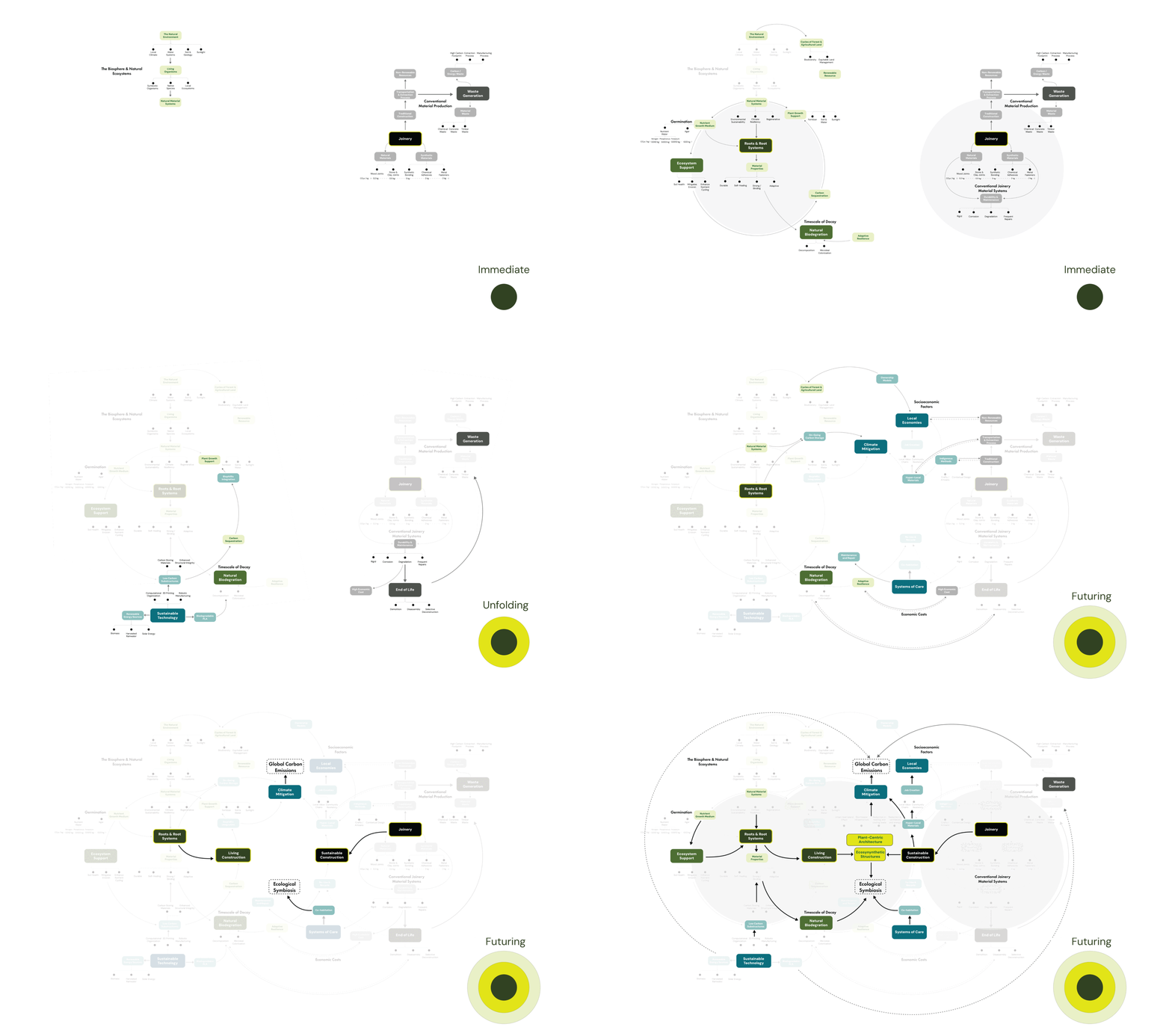
The system map outlines how scaffold geometry, growth medium, environmental conditions, and time interact to guide root propagation.
Growth Experiments
A series of physical experiments were conducted to observe how plant roots propagate through designed spatial constraints over time. Modular tiles were assembled in varying configurations and seeded using an agar-based medium to support early growth. Root development was documented through visual observation, sectioning, and comparative imaging across stages of growth.
The experiments focused on understanding how scaffold geometry, growth medium, and spatial proximity influence root behavior and connectivity. Rather than optimizing for a single outcome, the setup was designed to register variation, response, and interaction between biological growth and designed structure.


3D Printed Tiles

Agar Placed on 3D Prints - Agar-based medium supports early root development.

3D Printed Voxels

Seed Placement on Top
Experimental Observations
Our experiments revealed how plant roots respond to material, geometric, and environmental conditions when guided through designed scaffolds. Wheatgrass, with its fibrous root system, produced dense networks that adapted to channel porosity and spatial constraints, while variations in agar concentration, exposure, and sterilization significantly affected growth health and mold formation. Rather than optimizing for structural performance, this work documents how roots behave under varied parameters, foregrounding growth, care, and interaction as design variables. The resulting artifacts function more as provocations, suggesting alternative ways to think about material systems that evolve over time in partnership with living processes.

Four Tiles completely joined by Plant Roots

Plant Roots behavior - They move to the bottom and wrap around the edges

Close-up of Roots