

Woven-Root Tiles
Toward Fully Biodegradable Vertical Wall Elements
Guiding root growth into woven, biodegradable architectural matter
Publication · ACADIA 2025 (Accepted)
Role: Material Systems Research · Biological Fabrication · System Design
Team: Hana Khurshid, Isabelle Lee
Woven-Root Tiles investigates the potential of fibrous plant root systems to form fully biodegradable architectural elements through guided biological growth. The project explores how digitally fabricated, biodegradable scaffolds can direct root propagation to produce dense, interconnected mats capable of functioning as vertical wall components.
Through controlled material experiments using fibrous-root species such as wheatgrass, chia, and oat, the research examines how scaffold geometry, porosity, and growth conditions influence root density, continuity, and structural coherence. Rather than treating plant growth as a surface treatment or post-occupancy layer, roots are engaged as an active material process that develops strength and connectivity over time.
Presented at ACADIA 2025, this work contributes a biologically driven approach to architectural material systems; positioning growth, decay, and regeneration as integral design parameters for future biodegradable construction.

How can digitally fabricated biodegradable scaffolds guide fibrous root growth to form coherent, self-supporting architectural material systems?
Material Selection
Fibrous-root plant species were selected for their ability to form dense, interconnected networks suitable for continuous material systems. Wheatgrass, chia, and oat were chosen based on rapid germination, fine root density, and compatibility with soil-less growth conditions. In contrast, mung bean—characterized by a dominant taproot—was tested but proved less effective for forming continuous root mats.
All experiments employed biodegradable growth media to support early development while maintaining visibility and control over root propagation.

Materials Selected
Scaffold Fabrication
Scaffolds measuring 250 × 250 × 20 mm were fabricated using FDM 3D printing. Early prototypes were printed in PLA with a 0.4 mm nozzle and 60 mm/s print speed to provide dimensional stability during initial testing. Subsequent iterations transitioned to biodegradable materials to align with the project’s end-of-life objectives.
Print parameters were adjusted to support vertical fabrication, employing minimal tree supports and dissolvable PVA where required to preserve channel integrity while enabling full scaffold dissolution.

FDM 3D Printing BVOH
Scaffold Geometry
Scaffold geometry was varied to study how spatial configuration influences root propagation and material continuity. Key parameters included pore size and density, ranging from sparse openings to tightly packed perforations; wall thickness, tested for its effect on structural stability and moisture retention; and edge conditions, explored through continuous, segmented, and articulated boundaries to support inter-module connectivity.

Pattern Porosity & Density
Experimental Setup & Growth Conditions
Scaffolds were seeded using a 1% (w/v) agar solution prepared by dissolving agar powder in boiling water and pouring the solution over the printed scaffold. Seeds were placed within the agar matrix to initiate growth under soil-less conditions.

Preparation of tiles with agar solution
Experimental Observations
Root growth was examined across multiple scaffold orientations—horizontal, vertical, and inclined at 30°—as well as through different seeding and agar application strategies. These included selective coating, in which seeds were mixed with agar and applied in localized pockets; fully coated insertion, where seeds were submerged in agar prior to solidification; fully coated pressing, where seeds were pressed into the agar surface; and dual-sided pressing, in which two tiles were positioned vertically with seeds applied to both faces.

Selective agar application led to rapid dehydration, resulting in brittle, spatially confined roots. In several cases, roots exhibited lateral extension in search of moisture, indicating adaptive exploratory behavior under constrained conditions.

When seeds were pressed into the agar surface, early root coiling and strong engagement with the printed geometry were observed. Vertical and inclined orientations in particular promoted wrapping around tile edges and increased surface interaction.

In contrast, scaffolds with fully filled agar cavities produced consistent downward root growth but limited lateral spread. While root penetration through pores was observed, high moisture retention reduced root–scaffold binding within the cavities.

Scaffold Orientation & Root Spatial Adaptation
Root growth varied with scaffold orientation, responding primarily to gravity and moisture distribution.
-
Dual-sided: Enabled multi-directional growth, with roots bridging tile gaps and coiling within interstitial spaces.
-
Horizontal: Even moisture distribution produced dense, radial growth and the most consistent root meshes.
-
Inclined (30°): Roots clustered along lower edges, showing Z-axis entanglement where gravity and moisture intersected.
-
Vertical: Increased drainage led to localized growth, with roots concentrating in moisture-retaining zones.
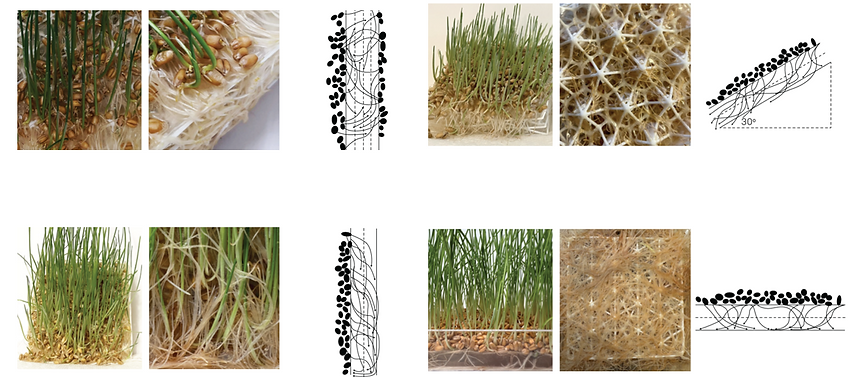
Scaffold Orientation and effects on root behavior
Seed Typology & Root Morphology
Different seed types produced distinct root architectures, affecting density, directionality, and interconnection.
-
Chia produced the highest root density, with near-continuous surface coverage observed across tiles.
-
Wheatgrass exhibited strong vertical growth and deep anchorage, with moderate lateral entanglement.
-
Mung Bean developed thick central taproots (approximately 2–3 mm diameter), but limited lateral branching reduced its effectiveness for distributed binding.
These variations highlight how biological selection directly influences material behavior within the system.

Microscopic images of root behavior
Scaffold Geometry & Root Engagement
-
Medium porosity: Balanced moisture retention and root penetration.
-
Sparse porosity: Limited anchoring and reduced engagement.
-
Dense porosity: Waterlogging and restricted root movement.
-
Thick walls: Slower dehydration, extended growth window.
-
Thin walls: Rapid drying, limited root spread.
-
Edge articulation: Encouraged early coiling and surface adhesion, especially in vertical setups.

Root engagement with scaffold geometry
BVOH Dissolvable Scaffold
-
Germination delayed by 1–2 days, likely due to pH interaction at the BVOH–agar interface.
-
Scaffold reached ~60% degradation by day 4 and fully dissolved by day 7.
-
The BVOH–agar composite exhibited greater elasticity than agar alone.
-
Supported dense, three-dimensional root entanglement during degradation.

Roots after BVOH dissolved completely
Future Directions
Root-grown materials present a promising pathway toward circular, biodegradable alternatives to synthetic composites, while offering ecological co-benefits such as microhabitat support, air filtration, and localized microclimate regulation.
This research envisions scaling the system into architectural elements; such as fencing, façade modules, or shading structures—that reintroduce living matter into urban environments while remaining fully biodegradable at end of life.
By tuning scaffold geometry, material composition, and growth conditions, root behavior and resulting material characteristics can be deliberately guided. Embedding biological growth directly into the design and fabrication process positions growth and decay as active design agents rather than terminal phases.

Future Application
ACADIA Presentation
We were honored to have the opportunity to present and publish our work at the ACADIA Conference 2025 (Miami)
